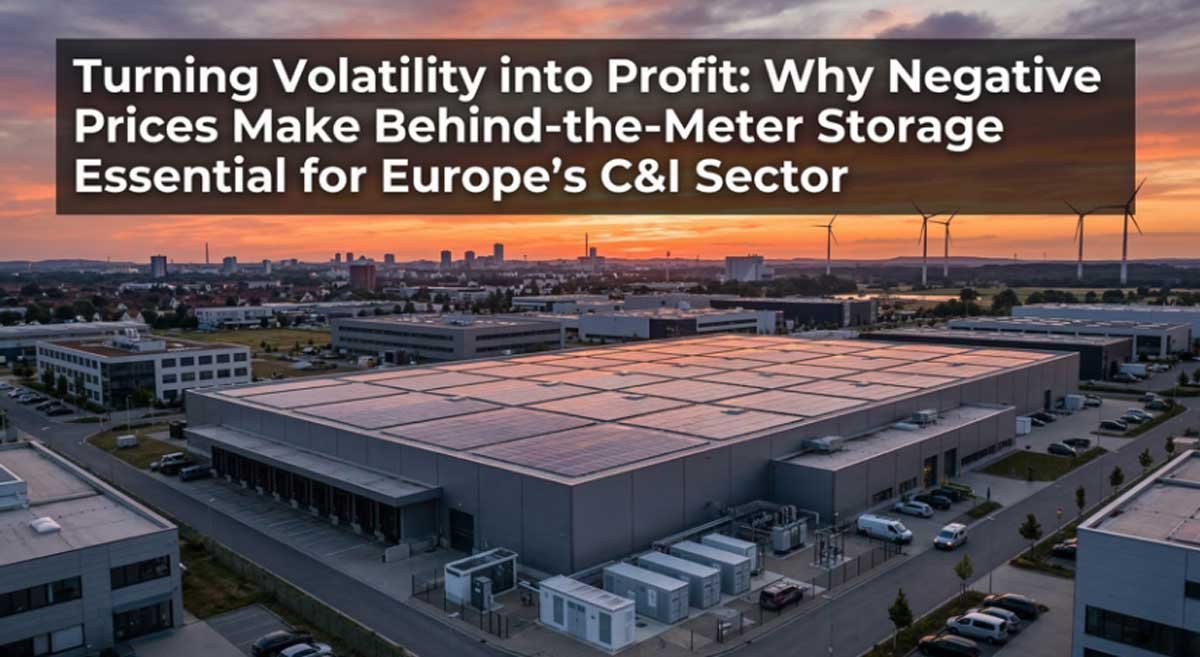
Europe’s rapid expansion of renewable energy has fundamentally changed the economics of electricity for commercial and industrial users. The grid no longer delivers stable, predictable prices — it delivers extreme volatility, with wholesale prices swinging from deeply negative to sharply positive within the same day. For factories, logistics hubs, and commercial buildings, this is no longer just a procurement headache. Managed correctly, it is a profit opportunity. Energy management has shifted from cost control to active arbitrage — and behind-the-meter battery storage is the tool that makes it possible. Sungrow is among the leading providers helping C&I businesses turn this shift into measurable returns.
The Negative Price Paradox — By the Numbers
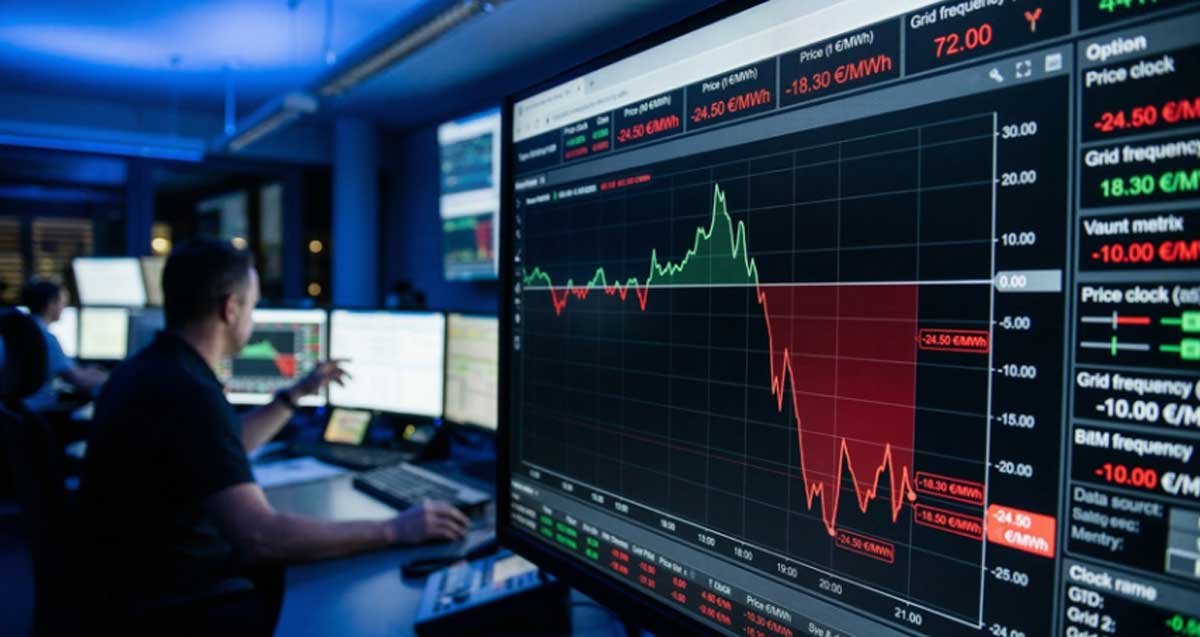
Negative electricity prices — where generators pay buyers to take excess power — were once rare events. They are now a defining feature of European energy markets. In the first eight months of 2024 alone, European wholesale markets recorded 7,841 hours of negative or zero prices, driven by solar and wind generation outpacing grid capacity to absorb it. [1] Germany logged 459 negative-price hours in 2024, up 52% year-on-year. Spain recorded negative prices for the first time in its history in April 2024, accumulating 247 hours over the year. [2] By 2025, the trend accelerated: Germany hit 573 hours (+25%), Spain doubled year-on-year, and the IEA confirmed that negative-price hours in Germany, the Netherlands, and Spain reached 8–9% of all trading hours in H1 2025 — up from 4–5% in 2024. [3][4] Prices in some instances fell below -€20/MWh. [5] With Europe set to add 89 GW of new renewable capacity in 2025 while grid infrastructure upgrades lag behind, this pattern is structural — not cyclical.
Two Projects, Two Outcomes
Negative prices create a fork in the road for energy asset owners. A solar-only project generates power precisely during the midday hours when prices are lowest — or negative. The asset is curtailed or forced to sell at a loss, becoming what analysts increasingly call a stranded liability during peak generation hours. A solar-plus-storage project does the opposite: it charges the battery during negative-price windows (effectively getting paid to consume electricity), then discharges during the evening peak when prices spike. The same grid condition that destroys value for one asset creates it for the other. Storage is the difference.
The BTM Arbitrage Strategy for C&I Users
For commercial and industrial users, behind-the-meter storage captures a double advantage. First, the arbitrage spread in BTM applications is larger than in wholesale markets, because businesses displace high retail electricity tariffs (not just wholesale prices) when they discharge stored energy. Second, they avoid demand charges — grid fees calculated on peak consumption — through peak shaving. In Germany’s day-ahead market, hourly prices in 2024 ranged from -€20/MWh to over €250/MWh. A battery that charges at the floor and discharges at the ceiling captures a spread exceeding €270/MWh within a single day. [7]
The Two-Strategy Playbook
Load Shifting: The battery charges during negative or near-zero price windows — typically midday solar surplus — and discharges during the evening demand peak. This is pure arbitrage: buy low (or get paid to buy), sell high (or avoid paying high retail rates).
Peak Shaving: By discharging during a facility’s peak consumption window, storage reduces the maximum demand recorded by the meter. In markets where grid tariffs are partially based on peak demand rather than total consumption, this alone can deliver meaningful bill reductions independent of price arbitrage.
The financial impact is significant. An Orkestra analysis of a UK small-to-medium enterprise — a 60 kW solar array paired with a 40 kWh battery — found that optimizing the battery for dynamic time-of-use pricing and arbitrage raised the project’s Net Present Value from £62,000 to £123,000, nearly doubling returns compared to solar-only self-consumption. [6] The broader market is responding: Europe’s installed BESS fleet grew by nearly 60% annually over the past four years, reaching 61.1 GWh of capacity, and the global behind-the-meter storage market was valued at $42.3 billion in 2024, projected to grow at a 19.5% CAGR through 2034. [10]
Explore how the Sungrow PowerStack 255CS is designed to support high-frequency arbitrage in C&I applications.
What the Technology Must Deliver — A Selection Framework
Not all C&I battery systems are built for high-frequency arbitrage. Capturing negative prices requires daily — sometimes multiple daily — charge/discharge cycles. The technology must meet three non-negotiable criteria.
1. High Cycle Durability Under Thermal Stress
Frequent cycling accelerates battery degradation unless thermal management keeps cell temperatures stable. The critical specification is cell temperature uniformity — systems that allow large temperature differentials between cells degrade faster and lose capacity over time. Liquid cooling is the current best practice for C&I applications operating under high-cycle regimes.
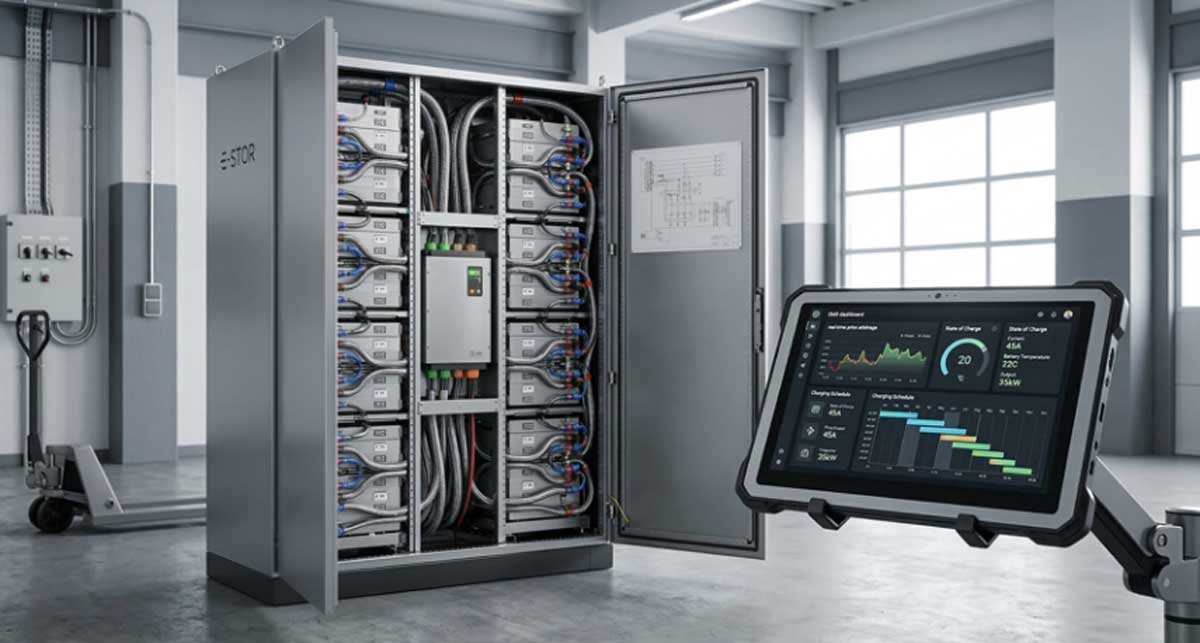
Sungrow’s PowerStack 255CS illustrates this standard: AI-controlled liquid cooling maintains a cell temperature differential of ≤2.5°C, delivers >90% round-trip efficiency, and is rated for a 20-year design life — all with a pre-commissioned, all-in-one form factor that can be installed and operational in under 8 hours. [9]
2. Predictive Energy Management Software
Capturing negative price windows requires anticipation, not reaction. By the time a price goes negative on the spot market, the opportunity to pre-position the battery may already have passed. Effective EMS platforms use AI-driven day-ahead price forecasting to schedule charging windows in advance, automatically optimizing for the maximum spread between anticipated low and high periods.
Sungrow’s iSolarCloud EMS integrates with day-ahead market signals and supports VPP (Virtual Power Plant) participation — meaning businesses can not only reduce costs but also earn revenue by making storage capacity available to grid operators during stress events. The system responds in 100ms, with data hosted on AWS infrastructure in Europe to meet regional data privacy requirements. [8]
For businesses evaluating C&I energy storage systems with advanced EMS capabilities, Sungrow’s PowerStack series supports both day-ahead market integration and VPP participation.
3. Bankability and Certification
C&I storage projects increasingly rely on green financing, EU taxonomy-aligned loans, or government incentive programs — all of which require internationally recognized safety certifications and independent technology assessments. The key standards for European commercial installations are UL9540 and NFPA 855; bankability ratings from organizations such as BloombergNEF reduce financing risk and accelerate lender approval. Sungrow holds both certifications and carries BloombergNEF’s No. 1 energy storage bankability rating, with over 1,000 C&I projects deployed globally across industries including metallurgy, automotive, and logistics. [8][9]
Conclusion
Europe’s electricity price volatility is structural. With 89 GW of new renewables coming online in 2025 and grid infrastructure years behind in catching up, negative prices will be more frequent and more prolonged, not less. For C&I businesses, this creates a clear strategic choice: remain exposed to price swings as a passive consumer, or deploy behind-the-meter storage and become an active participant in the market.
The businesses that move now — pairing solar assets with high-cycle, EMS-enabled storage — will not only protect themselves from negative-price curtailment. They will convert the same market conditions that strand competitors into a consistent, measurable revenue stream. As one industry analyst put it: “The question is no longer whether to invest in behind-the-meter storage — it’s how quickly you can deploy it.”[6]
References
[1] World Economic Forum / Financial Times, “Negative energy price record in Europe,” Sep 2024. https://www.weforum.org/stories/2024/09/negative-energy-price-record-in-europe-and-other-top-energy-stories/
[2] FfE, “European Day-Ahead Electricity Prices in 2024,” Jan 2025. https://www.ffe.de/en/publications/european-day-ahead-electricity-prices-in-2024/
[3] Bloomberg, “Europe Saw Record Surge in Negative Power Prices in 2025,” Jan 2026. https://www.bloomberg.com/news/articles/2026-01-05/europe-saw-record-surge-in-negative-power-prices-in-2025
[4] IEA, “Electricity Mid-Year Update 2025 — Prices,” 2025. https://www.iea.org/reports/electricity-mid-year-update-2025/prices-trends-in-wholesale-markets-differ-across-regions
[5] Carbon Credits, “Europe’s Power Paradox: Why Electricity Prices Went Below Zero in 2025,” Jan 2026. https://carboncredits.com/europes-power-paradox-why-electricity-prices-went-below-zero-in-2025/
[6] pv europe / Orkestra, “How Dynamic Tariffs Could Wake the Sleeping Giant of C&I Storage,” Jul 2025. https://www.pveurope.eu/markets/how-dynamic-tariffs-could-wake-sleeping-giant-ci-storage
[7] Battlink, “3 Proven Ways Commercial Battery Storage in Europe Cuts Costs and Generates Revenue,” May 2025. https://battlink.com/news/commercial-battery-storage-europe-profit-models/
[8] Sungrow / pv magazine, “Can Energy Storage Power Up a New Era for Europe’s C&I Players?,” Sep 2025. https://www.pv-magazine.com/press-releases/can-energy-storage-power-up-a-new-era-for-europes-ci-players/
[9] Sungrow, “PowerStack 255CS Launch,” PRNewswire, Apr 2025. https://www.prnewswire.com/news-releases/sungrow-launches-powerstack-255cs-a-next-gen-ci-energy-storage-system-redefining-efficiency-safety-and-convenience-302428292.html
[10] Grand View Research / GM Insights, “Behind the Meter Stationary Battery Storage Market Report,” 2024. https://www.gminsights.com/industry-analysis/behind-the-meter-stationary-battery-storage-market