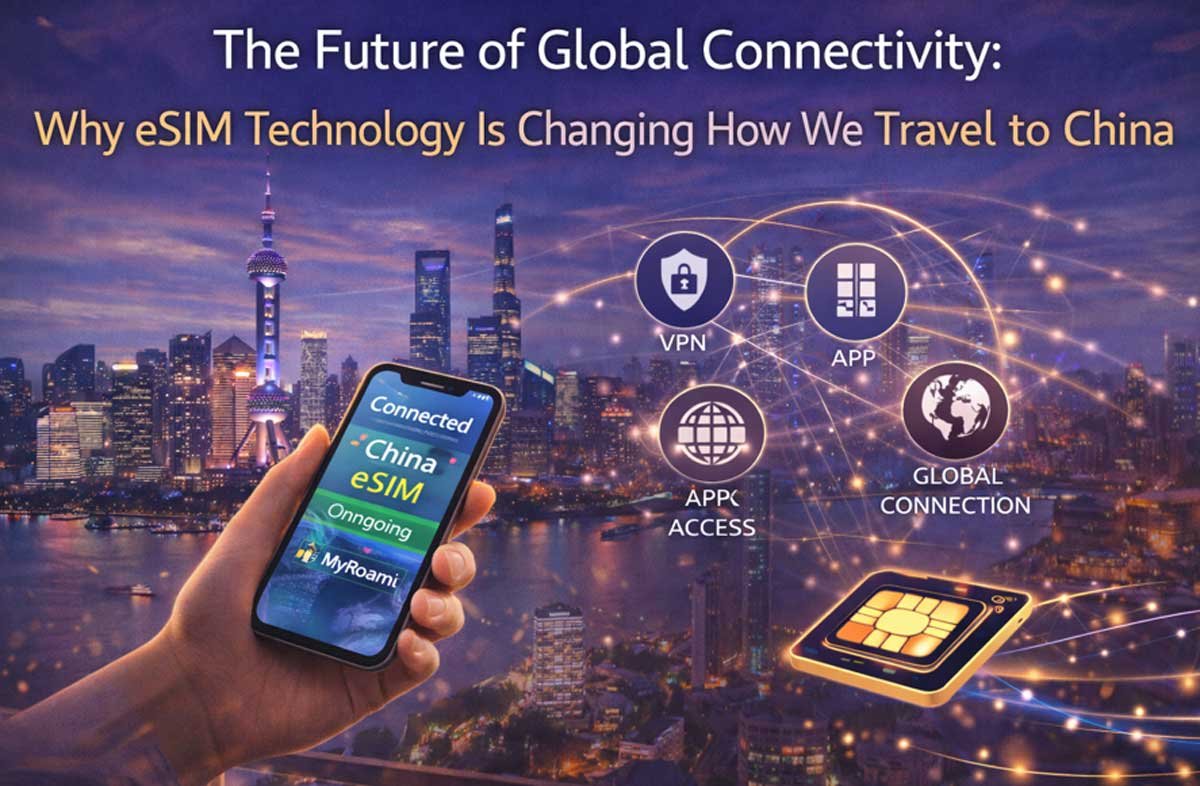
For decades, mobile connectivity has relied on a small, removable piece of hardware: the SIM card. It was a simple solution for a different era—one where phones were tied to carriers, borders defined connectivity, and international travel meant swapping plastic chips at airport kiosks.
But in 2025, that model is rapidly becoming obsolete.
As industries shift toward software-defined infrastructure, telecommunications is undergoing its own transformation. The rise of eSIM technology is not just an incremental upgrade—it represents a fundamental change in how devices connect to networks, particularly in complex digital environments like China.
For travelers, entrepreneurs, and globally distributed teams, this shift is reshaping expectations around mobility, reliability, and control.
From Hardware to Software: A Structural Shift
The traditional SIM card is a legacy of hardware-first design. It requires physical handling, manual replacement, and in-person distribution. In an era where everything from computing to payments has moved into the cloud, this dependency on physical infrastructure feels increasingly out of place.
eSIM (embedded SIM) technology eliminates the need for removable cards. Instead, network profiles are downloaded directly onto a device, allowing users to switch carriers or activate plans through software.
This shift aligns with broader trends across the tech ecosystem:
- Cloud computing replacing on-premise servers
- Streaming replacing physical media
- SaaS platforms replacing installed software
- Digital wallets replacing cash
Connectivity is following the same trajectory—moving from static hardware to dynamic, software-driven systems.
China: A Unique Connectivity Environment
While eSIM adoption is global, its impact becomes especially apparent in destinations with distinct digital ecosystems. China is one of the most notable examples.
The country offers world-class mobile infrastructure, including widespread 4G and rapidly expanding 5G coverage. However, its internet architecture differs significantly from that of the United States and Europe.
Certain widely used Western services—such as Google-based platforms, cloud storage tools, and messaging applications—may not function as expected without preparation. This creates a layer of complexity for travelers who rely on digital tools for navigation, communication, and productivity.
For tech professionals, startup founders, and remote workers attending conferences or exploring partnerships in China, connectivity isn’t just about convenience—it’s about operational continuity.
In this context, the limitations of traditional roaming or last-minute SIM purchases become more apparent.
eSIM as a Software-Defined Solution
eSIM technology addresses many of these challenges by enabling users to activate mobile data plans before they even arrive in a new country.
Instead of searching for a local SIM vendor or navigating unfamiliar pricing structures, travelers can download a data profile in advance. The moment they land, their device connects automatically.
Key advantages include:
- Pre-activation: Plans can be installed before departure
- Instant connectivity: No delays upon arrival
- Device flexibility: No need to remove a primary SIM
- Transparent pricing: Prepaid plans with defined limits
- Multi-region support: Easy switching between destinations
From a systems perspective, eSIM transforms connectivity into an API-like service—configurable, scalable, and integrated into the device experience.
Comparing Connectivity Before You Land
As awareness of eSIM technology grows, travelers are adopting a more deliberate approach to connectivity planning.
Rather than relying on default carrier options, many now evaluate multiple providers before departure. This shift mirrors how users compare cloud services, SaaS tools, or financial platforms—based on performance, pricing, and reliability.
As travelers become more digitally aware, many now research connectivity solutions in advance, choosing to Find the best eSIM in China with MyRoami to compare coverage, pricing, and performance before departure.
This behavior reflects a broader consumer trend: decision-making driven by transparency and optionality.
In a world where digital services are expected to be customizable, connectivity is no exception.
Who Benefits Most from This Transition?
While eSIM technology benefits a wide range of users, certain groups experience its advantages more acutely:
Digital Nomads and Remote Workers
For professionals operating across borders, uninterrupted connectivity is essential. eSIM eliminates friction when moving between countries.
Startup Founders and Entrepreneurs
Business travel often involves tight schedules, multiple meetings, and cross-border communication. Immediate connectivity supports agility.
Engineers and Technical Teams
Access to cloud environments, version control systems, and internal tools requires stable data connections.
Conference Attendees and Industry Professionals
Events increasingly rely on digital platforms for scheduling, networking, and information sharing.
Frequent International Travelers
For those crossing borders regularly, managing multiple physical SIM cards becomes impractical.
In each case, the ability to configure connectivity digitally aligns with modern workflows.
The Broader Impact on Telecom and Travel Tech
The rise of eSIM is not an isolated trend—it signals a deeper transformation within the telecommunications industry.
Carriers are shifting toward digital provisioning. Devices are being designed without SIM trays. Connectivity marketplaces are emerging, allowing users to compare plans globally.
This evolution parallels the development of cloud computing marketplaces and app ecosystems.
Travel, as an industry, is particularly sensitive to these changes. As booking, payments, and navigation become fully digital, connectivity becomes the underlying layer that enables everything else.
In this sense, eSIM is less a feature and more an infrastructure upgrade.
Toward Invisible Connectivity
The ultimate goal of technological progress is invisibility. The most successful systems are those users no longer have to think about.
Cloud computing achieved this by abstracting hardware. Streaming services did the same for media. eSIM is moving connectivity in that direction.
When users can activate data plans in seconds, switch providers without friction, and remain connected across borders seamlessly, connectivity fades into the background.
It becomes an assumption rather than a concern.
Conclusion: A New Standard for Global Mobility
As the world becomes more interconnected, the tools that support mobility must evolve. The traditional SIM card, once a cornerstone of mobile communication, is giving way to a more flexible, software-defined alternative.
For travelers heading to complex digital environments like China, this shift is particularly meaningful. It reduces uncertainty, enhances control, and aligns connectivity with the expectations of a digital-first world.
eSIM technology is not just changing how we connect—it’s redefining what we expect from connectivity itself.
And in the near future, the idea of searching for a SIM card at an airport may feel as outdated as printing boarding passes.
The infrastructure of global mobility is becoming invisible—and that’s exactly the point.