Louis Chênevert has dedicated his career to optimizing systems at some of the world’s largest aerospace and automotive manufacturers. Early in his career, he worked as a production general manager at a General Motors plant in Quebec, overseeing the assembly of Chevy Camaros and Pontiac Firebirds. He joined Pratt & Whitney Canada in 1993 and advanced to become President of the global Pratt & Whitney from 1999 to 2006. He was named a director, COO, and president of Pratt’s parent company, United Technologies Corporation (UTC), that year before being elected CEO of UTC in April 2008 and Chairman in 2010.
When Mr. Chênevert retired in December 2014, UTC had a market capitalization of $105 billion and boasted sales nearing $70 billion. The conglomerate stood out as one of the relatively few success stories in American manufacturing during this era, delivering almost 12% in average annual returns (vs 8.4% for the S&P 500) during Mr. Chênevert’s tenure as CEO from 2008 to 2014.
This success grew out of innovative products like Pratt & Whitney’s Geared Turbofan engine for airliners and F135 for the Lockheed Martin F-35 strike fighter. UTC and its subsidiaries also realized major productivity gains and quality improvements by embracing a philosophy of business rooted in the Japanese concept of kaizen.
Kaizen
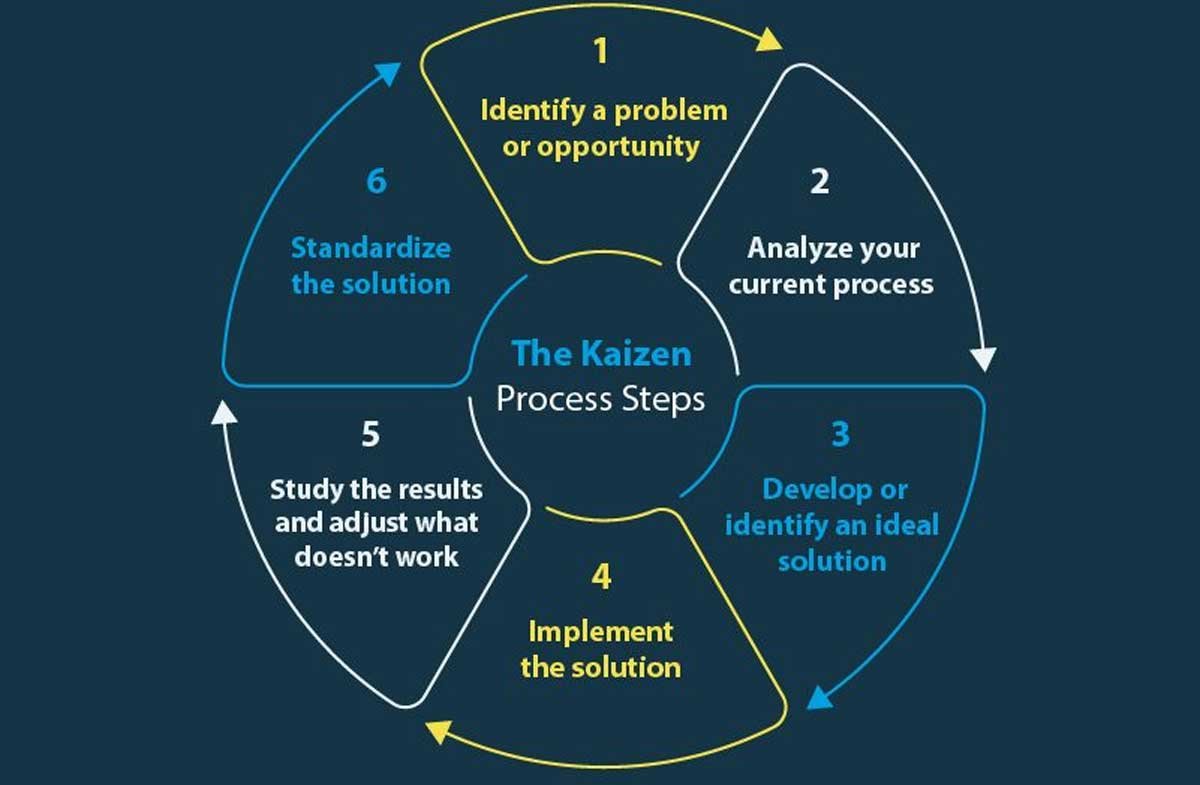
Kaizen is a Japanese business philosophy aimed at continuous improvement. As Mr. Chênevert explains, ”I have always focused on improving everything I am involved with, and I was blessed to have learned the techniques from kaizen in Japan early in my automotive career—and from a master at fixing issues, Yuzuru Ito—which drove a profound culture change to fix issues that affected our products.” Mr. Chênevert championed these techniques at both Pratt & Whitney and UTC, especially within the Achieving Competitive Excellence (ACE) program.
Kaizen means “improvement” or “change for the better,” with the understanding that perfection is never achieved—and so efforts to change and progress must be continuous. Kaizen can be applied throughout the corporate structure to all business operations, purchasing, logistics, manufacturing, and supply chain activities. In the West, kaizen has also come to refer to a system of business process improvement that emphasizes “zero investment improvement,” or using existing resources to achieve gains.
Perhaps most critically, kaizen emphasizes the importance of investigating the root cause of a problem and examining every detail, no matter how small, before taking corrective action to address it. It assumes that the workers doing a particular job know best how to do it and that they should lead process improvements. Ideally, every worker within the organization is empowered to identify problems—such as inefficiencies, obstacles, inaccurate assumptions, deviations, waste, and communication roadblocks—and take action. This contrasts with many businesses’ tendency to sweep difficult problems under the rug and focus on successes more than mistakes.
The strength of the kaizen approach is its universal applicability. Indeed, companies that embrace kaizen encourage its integration at all levels, from executives to assembly line workers on the shop floor. The approach involves a cumulative series of small improvements to every aspect of a business’s operations, and can result in a more efficient, “lean” system that prioritizes continuous self-learning and progressive refinement.
History of Kaizen
While kaizen is nearly ubiquitous in the business world, a couple decades ago it was still an approach primarily known in the East. It was born in Japan as the country sought to rebuild its industrial capacity after World War II. Several American and Japanese manufacturing and production experts developed its principles, including American statistician Edwards Deming, who promoted statistical process controls and a “Plan, Do, Check, Act” cycle of continual improvement.
Kaizen gained global prominence later in the 20th century as part of the “Toyota Way.” This system developed by the automotive giant drew on concepts such as just-in-time manufacturing, total productive maintenance, and, most importantly, perpetual self-learning and improvement.
Kaizen and UTC’s Achieving Competitive Excellence (ACE) Program
Variations on the kaizen approach have yielded process improvements for several of the world’s leading companies. UTC’s ACE program stands as one of the most notable and successful of the late 20th and early 21st century. It was developed and implemented by Mr. Chênevert; his predecessor as CEO, George David; and other leaders within UTC and its subsidiaries.
Critically, the ACE program was informed by the work of Yuzuru Ito, a Japanese business leader who oversaw one of the most successful quality control programs of the late 20th century at Matsushita Electric (branded in the US as Panasonic). When UTC subsidiary Otis Elevators ran into quality control issues in Japan, the company learned from Mr. Ito, who taught factory workers how to use statistical analysis to diagnose the root causes of problems and to organize small teams focused on quality improvements. He later became UTC’s lead quality officer and gave his name to Ito University, a three-day course that taught UTC managers his principles.
Meanwhile, Pratt & Whitney worked in the early 1990s with a consulting firm founded by protégés of Taichi Ohno, architect of the kaizen-influenced Toyota Way. Pratt also adopted principles of lean manufacturing, a complementary framework based on eliminating waste, addressing mistakes and abnormalities quickly, and empowering workers to improve processes.
In addition, the company embraced the creation of small teams, or cells, within production units to facilitate learning, diagnose problems, and apply and iterate on quality improvement techniques. Mr. Chênevert sponsored these and similar initiatives as EVP Operations of Pratt & Whitney Canada, EVP Operations of Pratt & Whitney, and President of the division.
Pratt & Whitney’s ACE program formally launched in 1996. Not long after, UTC executives decided to implement a version of it throughout the entire conglomerate. After he left Pratt and became COO of UTC in 2006, Mr. Chênevert kickstarted a drive to have 70% of plants certified as ACE gold or silver—the two highest levels—by 2009. The company met this goal on time and benefited from the resulting improvements in sales, inventory turnover, and customer satisfaction rates. Later, as CEO, Mr. Chênevert also initiated a similar effort to get 70% of UTC suppliers certified at the two highest ACE rating levels by 2009, another goal the company met on schedule.
Inspired by kaizen and similar business frameworks, the ACE program was a key driver of UTC’s success during 2000s and into the 2010s. During this period, UTC was among the highest-performing Fortune 50 companies, outcompeting rivals GE and Boeing in terms of profitability and performance for investors.