Monday, December 15, 2025
Mitmunk
  • Home Improvement
  • Finance
  • Lifestyle
  • Business
  • Seo Digital
  • Auto
  • Law
  • Health
  • Other
    • Travel
    • Outdoor
    • Fashion
    • Entertainment
    • Construction
    • Education
    • Tech
    • Pet
    • Real Estate
No Result
View All Result
  • Home Improvement
  • Finance
  • Lifestyle
  • Business
  • Seo Digital
  • Auto
  • Law
  • Health
  • Other
    • Travel
    • Outdoor
    • Fashion
    • Entertainment
    • Construction
    • Education
    • Tech
    • Pet
    • Real Estate
No Result
View All Result
MitMunk
No Result
View All Result
Home Tech
The Freeform app

The Freeform app: Things You Need to Know

Share on FacebookShare on Twitter

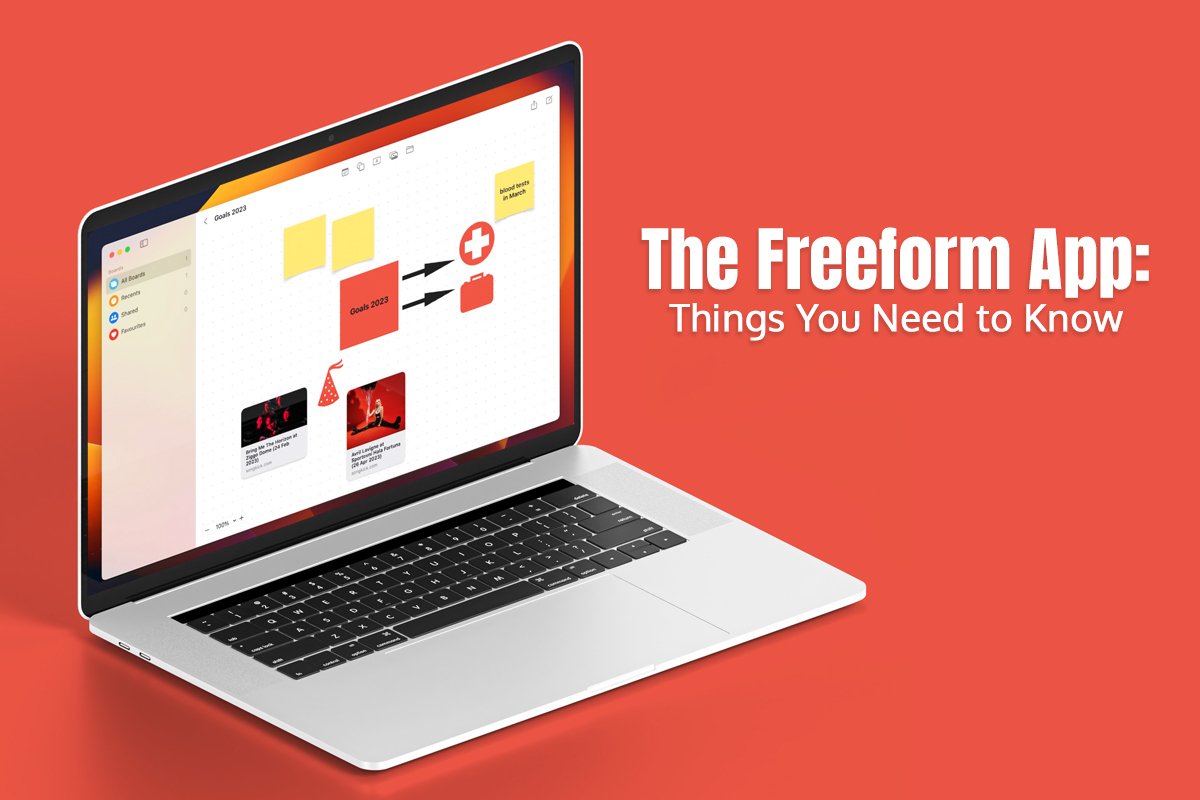
Freeform is Apple’s newest application, debuting with macOS 13.1, iPadOS 16.2, and iOS 16.2. It is a limitless whiteboard where you can brainstorm, collect ideas, plan your holidays, or collaborate with your team. This app allows you to draw, write, add documents, add pictures, etc.

If you have upgraded your device to the latest OS version, the app icon will automatically appear on your screen. However, before you hide or delete the Freeform app from your device, here’s what you must know.

Table of Contents

Toggle
  • What is the Freeform App?
  • Are There Any Problems With the App That You Must Know about?
  • How Does the App Work?
  • What items Can be Added to the App’s Canvas?
  • Can You Edit the Canvas?
  • Conclusion

What is the Freeform App?

Apple’s Freeform is a collaborative whiteboard application that allows people to work on the same document simultaneously. The app resembles Docs and Office apps developed by Google and Microsoft. The idea behind this app is the same as any whiteboard app – everyone can contribute and participate in a project.

In real-time, you can create diagrams, draw, take notes, and share different content forms, including photos, videos, PDF links, and web links.

Although Apple’s Freeform is not the only whiteboard collaborative app on the App Store, it is one of the most user-friendly with an intuitive interface. Also, the app efficiently works across Apple devices. But, unfortunately, it lacks cross-platform support.

Are There Any Problems With the App That You Must Know about?

Many users have reported the Freeform not working problem, which might range from the app crashing frequently or not syncing data.

If you cannot see the app on your device, upgrade your system to the latest OS version.

If you cannot sync the app with iCloud, check your Wi-Fi connection and then turn on iCloud syncing by going to System Settings > Apple ID > iCloud Drive > Freeform.

If problems persist, delete and reinstall the app from the App Store.

How Does the App Work?

When you open the app, you will see a blank canvas and a range of digital tools needed to draw, take notes and create tables. The app’s interface is similar to iWork and Notes apps. Therefore, it won’t take you more than a few minutes to use the Freeform app.

For sketching or doodling, you must select a set of digital tools. You can customize them to fit your needs. However, as mentioned earlier, the app is not limited to drawing or taking notes. You can add images, links, texts, videos, etc.

The app’s interface features a grid where you can add sticky notes, drawings, photos, shapes, videos, and more, to make your project interesting. You can select from various shapes of animals, food, science, people, symbols, etc. If you are working on the Freeform app on your iPad, you can use the Apple Pencil to write directly on the sticky notes.

If you have finished collaborating on a project, you can download it and save it as PDF.

What items Can be Added to the App’s Canvas?

  • Videos, photos, and scans

Onto the Freeform’s canvas, you can directly scan documents using your iPad. iPadOS 16’s scanning engine allows users to scan their documents quickly and include them in the Freeform app.

You can even add pictures from the library or take new photos using your camera. You can edit and crop if you do not need the full image. Furthermore, you can add shadows to the pictures or smooth the edges.

Besides scans and photos, you can add videos of any length and size. You do not have to leave the whiteboard to play the video. Furthermore, you can play the video on full-screen if you want.

  • Sticky notes

To make your canvas intuitive and interesting, you can add sticky notes. These come in several colors, and you can choose your preferred color. Then, align the text to the sticky notes’ top, bottom, or center; they even come with text options.

  • Links and other content

You can create web clips in the application by adding relevant links to your canvas. Since whiteboards work with several visuals, it makes sense to transform them into web clips. The app allows you to add files to your note as well. The files might be .pptx, PDF, zip, .docx, etc. Although you can open these files to read, you will not get any Markup tools.

Can You Edit the Canvas?

Everything on the whiteboard or canvas can be edited and customized to suit your project. For example, you can resize, rotate, duplicate, or delete the text written on the canvas or the images added. You can even lock the canvas so that further edits can be prevented.

Conclusion

The Freeform application is an excellent tool for collaborating and collecting your thoughts. You must not push this app away without trying. The features and user-friendliness of this app may convince you to ditch the Notes app or other whiteboard apps and make your life easier.


Related Posts

The Technology Powering Modern Medical Imaging

The Technology Powering Modern Medical Imaging

by Emily Stevens
December 11, 2025
0

Medical imaging has reshaped how healthcare professionals understand the human body. Instead of relying solely on physical symptoms or exploratory...

A Beginners Guide to Hazy Pale Ales: Flavour, Aroma, and Mouthfeel Explained

A Beginners Guide to Hazy Pale Ales: Flavour, Aroma, and Mouthfeel Explained

by Emily Stevens
December 5, 2025
0

If you’ve wandered through a craft beer fridge lately, you’ve probably noticed the growing number of hazy, juicy, pastel-coloured cans...

How Do You Identify the Best Storage Solution for Your Needs?

How Do You Identify the Best Storage Solution for Your Needs?

by Emily Stevens
November 24, 2025
0

If you were searching for self storage units online, you probably know that there are different types that you can...

POPULAR NEWS

Delores Miller Clark

Delores Miller Clark: Learn More about John List’s Ex-Wife

September 27, 2022
Lisa Seal Frigon

Lisa Seal Frigon: All about Drug Lord Barry Seal’s Daughter

September 18, 2022
Linnell S. Nobori

Linnell S. Nobori: All there is to Know about Ted Bessell’s Wife

September 5, 2022
Gweneth Gonzales Thomas

What You May Not Know About Gweneth Gonzales Thomas, Richard Thomas’ Daughter

August 2, 2022
Deserai Anderson Utley Personal Life, Career, & More

Deserai Anderson Utley Personal Life, Career, & More

September 30, 2022

EDITOR'S PICK

How an Instant Cash Offer for House Speeds up Your Home Selling Process

How an Instant Cash Offer for House Speeds up Your Home Selling Process

May 24, 2025
Protect Your Company's Data with Cryptographic Keys in a PKI Environment

Protect Your Company’s Data with Cryptographic Keys in a PKI Environment

September 6, 2023
Assets worth billions of dollars disappear every year. Since asset tracking systems rely on antiquated paper-based systems prone to human error, they can be misplaced, stolen, or just forgotten entirely. According to research conducted, foreign businesses are allegedly "losing" AU$4.3 billion ($2.92 billion) in assets annually as a whole. If you extrapolate the figures worldwide, it becomes clear that there is an issue with tracking physical assets in the workplace or across several organizations. Asset monitoring systems Reports show that despite the availability of low-cost, dependable wireless asset tracking solutions, half of all businesses still manually log their assets, and for thirty-five percent of businesses, having an employee walk around the premises to locate assets is their primary method of tracking assets. Every organization loses several staff hours annually on average while looking for misplaced tangible assets. Even worse, the study shows that only 22% of the time are the assets retrieved. However, things don't have to be this way. How Does GPS Asset Tracking Operate and What Is It? Most people are familiar with GPS technology from its use in mobile devices and smartwatches for location-based functions like mapping. However, GPS may be utilized for many more purposes, such as asset tracking. We’re sure you're wondering what exactly asset tracking means. Using GPS to track assets by corresponding with satellites is known as GPS asset tracking. An asset's location and movement can be tracked as long as it is equipped with a GPS tracker. As a result, assets can be found using their actual location, thus increasing asset visibility and lowering the possibility of missing assets. How to Track Your Lost Assets 1. Global Positioning System (GPS) What It Is: GPS asset tracking is a satellite-based navigation system that gives location and timing information in all-weather situations, anywhere, with an unobstructed line of sight to four or more GPS satellites. How It Works: GPS operates by a network of satellites that deliver signals to GPS receivers. The receiver determines its position by monitoring how long signals from numerous satellites take to reach it. By triangulating these signals, the receiver can pinpoint its precise location. This data is subsequently forwarded to a central system for monitoring and analysis. GPS devices are attached to assets like automobiles, machinery, and high-value equipment to track them accurately. Moreover, these gadgets continuously transmit position data to a central tracking system, allowing organizations to follow their assets in real-time. Also, you can employ a RAM tracking system to track assets that travel frequently or over long distances, ensuring they are always where they should be. 2. Passive RFID tags Passive RFID tags are made up of three components: a chip, an antenna, and a substrate. • The chip holds data and, depending on its design, can be read-only (RO), write-once, read-many (WORM), or read-write. Memory spans from 2 to 1000 bits. • The antenna picks up radio-frequency (RF) waves from the reader's signal and transmits and receives information. The size of its antenna determines the capacity of a passive RFID tag. 3. Active RFID tags Active RFID tags also have a microprocessor and an antenna. However, the chips are often larger and more capable than passive tags. Long-range RFID tagging is accomplished with active tags using Bluetooth, low-energy, high-frequency, or ultra-high frequency. They have two additional features that set them apart from passive tags: an inbuilt power supply and electronics. The power source is often a battery, although it can also be solar. Unlike passive tags, the tag's built-in power supply allows it to transmit data to a reader without relying on the reader's power. Active tags can be read from distances of 100 feet or more, while passive tags can only be read up to 20 feet away. Onboard electronics sensors, microprocessors, and input/output ports are all possible components of the tag's onboard electronics. Speaking of, active RFID tags can be used in more applications than passive tags due to their electronics. 4. Cellular IoT technology. Not all asset monitoring involves identifying misplaced or stolen equipment in offices, warehouses, and factories, and some tracking difficulties necessitate a low-power solution that exceeds the capabilities of Wi-Fi access points, RFID readers, and Bluetooth LE-powered gateways. This explains, at least in part, why cellular-based low power wide area network (LPWAN) technologies are expected to increase significantly in the future years. According to telecoms giant Ericsson, cellular IoT connections will increase from 700 million in 2017 to 3.5 billion by 2023, while analyst ABI Research predicts that nearly half of LPWAN connections by 2023 will be for asset tracking applications. What are the advantages of asset tracking and management? IT asset managers can use RF Code's CenterScape platform to track what's most important, such as location, temperature, and much more. 1. Improves efficiency Regular maintenance on data center assets such as hard disks and servers requires physically removing them from a rack server. When these assets are presented to the service department, people have a tendency to misplace or mislabel them. IT administrators can significantly shorten the time it takes to locate lost hard drives or servers by digitally tracking them. 2. Enables proactive monitoring of essential assets In addition to detecting lost or misplaced assets, data center asset tracking enables IT professionals to proactively manage essential equipment states such as cooling and power. 3. Significantly enhances work-in-process tracking IT managers must oversee all stages of data center operations, from installation to maintenance. IT administrators may eliminate guesswork with data center asset tracking since RFID tagging offers real-time work status information from the floor or the field. 4. Simplifies auditing Asset tracking entails taking an accurate inventory of data center assets, right down to location details. This is just difficult to do with manual inventory techniques. Digital asset tracking minimizes costly and time-consuming human errors while significantly simplifying auditing processes. 5. Encouraging Adherence to Regulations Depending on your sector and jurisdiction, having an efficient asset management system can assist in achieving several types of regulatory compliance. For example, the IRS mandates that all companies keep accurate records of their assets. These contain information about discounts, depreciation rates, equipment or inventory acquisition prices, etc. In addition, the FASB has recently updated its asset leasing policies. Upgrading from manual records to smart asset management software is the most reliable option to achieve complete compliance in the dynamic asset management landscape. In the end! Ultimately, asset tracking can assist businesses in tracking and managing asset utilization in addition to protecting them. That said, GPS asset tracking is a significant tool for companies to optimize asset management and ensure safety. By implementing asset management technology, your business can be equipped with real-time monitoring and tracking, proactive maintenance, and geofencing.

How To Find Lost Assets Using Tracking Devices

October 23, 2024
Top Trends in Dentistry

Top Trends in Dentistry: From Cosmetic Enhancements to Preventive Care

August 27, 2024
Contact Us: Info@mitmunk.com

© 2022 Mitmunk Theme Copyright

No Result
View All Result
  • Homepages
    • Home Page 1
  • Business
  • Entertainment
  • Fashion
  • Health
  • Lifestyle
  • Tech
  • Travel

© 2022 Mitmunk Theme Copyright