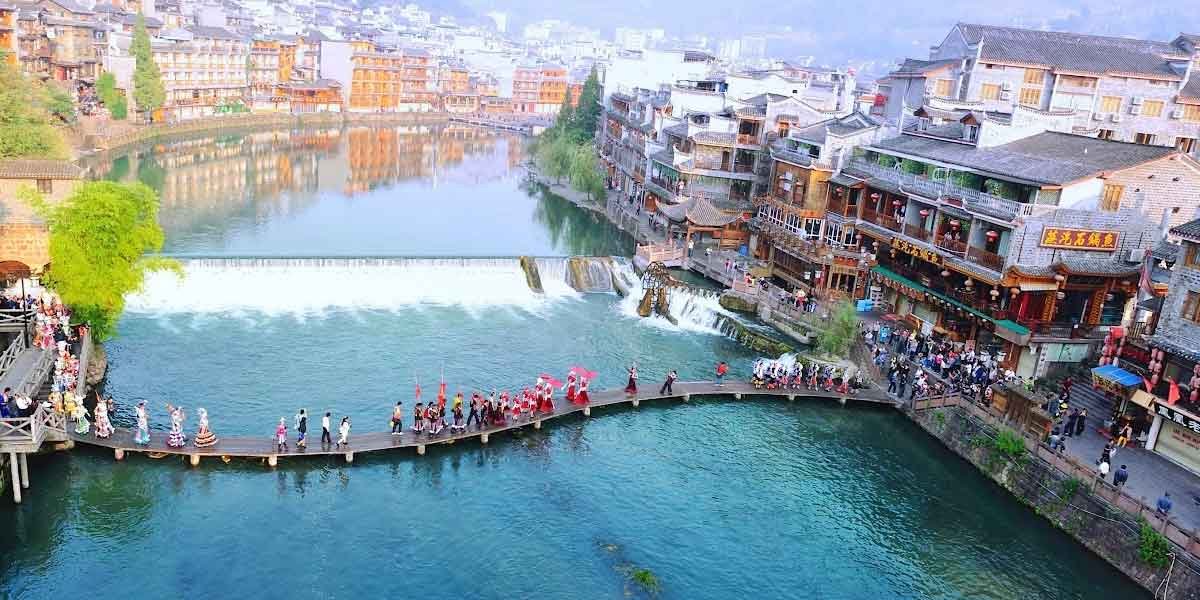
China’s most photographed destinations — the Great Wall, the Forbidden City, the Li River karst landscape — are well documented and heavily visited. What receives considerably less international attention is the country’s extraordinary wealth of rural and village architecture, much of it centuries old, spread across provinces that rarely appear on standard tourist itineraries. For travelers willing to move beyond the obvious, and for those who started to learn Mandarin online or with an online Chinese teacher, developing a deeper interest in Chinese history and geography through study or through working, the lesser-known destinations offer a more textured and also less crowded encounter with the country.
Hongcun and the Ancient Villages of Anhui
Tucked into the foothills of the Huangshan mountain range in southern Anhui province, Hongcun is one of the best-preserved examples of Huizhou vernacular architecture in China. The village was founded during the Song Dynasty and developed significantly during the Ming and Qing periods, when wealthy salt and tea merchants built the elaborate courtyard homes that still define the settlement today. The architecture is immediately distinctive: whitewashed walls, dark grey tile roofs with upturned eaves, and interior courtyards centered around a small rectangular skywell — a narrow opening in the roof designed to channel rainwater into a stone basin below, symbolically “gathering wealth” into the home. The interiors are often richly decorated with carved wood panels, stone screens, and ink-wash paintings, reflecting the cultural aspirations of the merchant class that commissioned them.
What makes Hongcun particularly striking from a visual standpoint is its water system. This is because the village was designed around a network of artificial canals that channel water from a nearby stream through every lane and courtyard before emptying into the central Moon Pond and the larger South Lake at the village’s edge. The reflection of whitewashed buildings in still water at dawn or dusk has made Hongcun one of the most painted and photographed villages in China, and a UNESCO World Heritage Site since 2000.
Zhangjiajie’s Village Culture Beneath the Peaks
Most visitors to Zhangjiajie in Hunan province come for the sandstone pillar formations that inspired the floating mountains in the film Avatar. Fewer take the time to explore the Tujia minority villages that sit in the valleys and lower slopes surrounding the national park. The Tujia people are one of China’s 55 officially recognized ethnic minorities, with a distinct language, architectural tradition, and cultural calendar that differs substantially from Han Chinese norms. Traditional Tujia homes are built in a style called diaojiaolou — stilted wooden houses cantilevered over slopes or water, with hanging balconies supported by wooden columns below. The construction technique is a direct response to the mountainous terrain, allowing homes to be built on ground that would otherwise be unusable. Villages like Pipa Creek and Shibadong — the latter famous as the starting point of a nationally recognized poverty alleviation program — offer access to this architectural tradition alongside local food, festivals, and craft markets.
The Rainbow Mountains of Zhangye and the Villages Below
The Zhangye Danxia landform in Gansu province — a series of eroded sedimentary rock formations displaying an extraordinary range of reds, oranges, yellows, and greens — has become increasingly known internationally in recent years, largely through social media. What draws photographers is the surreal quality of the color banding across the hillsides, produced by centuries of mineral deposition and erosion. Less discussed is the broader Hexi Corridor context in which Zhangye sits. This stretch of Gansu was one of the most strategically important sections of the ancient Silk Road, connecting China’s interior to Central Asia, and the towns and villages of the region carry traces of that history. Zhangye city itself contains a large reclining Buddha statue dating to the Western Xia dynasty, as well as a mosque district reflecting the area’s substantial Hui Muslim population. For travelers approaching China’s northwest as a cultural and historical region rather than simply a landscape destination, the villages and towns around Zhangye reward deeper exploration.
Kaiping Diaolou: Watchtowers of the Pearl River Delta
In Guangdong province’s Kaiping county, really an unusual architectural phenomenon developed between the late 19th and early 20th centuries: the diaolou, a series of fortified multi-story towers built by returning overseas Chinese emigrants who had made money in Southeast Asia, North America, and Australia. The towers were designed simultaneously as residences, symbols of status, and defensive structures — built to protect families and valuables during a period of regional instability and banditry. What makes the Kaiping diaolou visually remarkable is their stylistic eclecticism. Builders drew on architectural references from wherever they or their patrons had traveled — Greek columns, Baroque cornices, Islamic arches, and Venetian balustrades appear alongside traditional southern Chinese rooflines and decorative motifs. The result is a landscape unlike anything else in China: over 1,800 towers scattered across rice paddies and village lanes, each one a material record of migration, wealth, and cultural hybridity.
The villages of Zili, Majianglong, and Jinjiangli contain some of the best-preserved clusters and are accessible as day trips from Guangzhou. The area was designated a UNESCO World Heritage Site in 2007.
Language Teaching and Culture
Visiting rural and minority regions of China presents specific linguistic challenges that standard tourist Mandarin does not always address. Dialects, minority languages, and regional accents vary significantly across the areas described above — Cantonese is dominant in Guangdong, while Tujia and local Hunanese dialects are prevalent in Zhangjiajie’s villages. However, Mandarin remains functional as a lingua franca across all of these regions, and having a working knowledge of it transforms the nature of a visit.
Some teaching institutions like GoEast Mandarin’s online has programs which are designed to build the kind of flexible, listening-oriented fluency that allows learners to grasp unfamiliar accents and informal speech — their tutors are trained to work with students at all levels, from complete beginners building a foundation before a first trip, to intermediate learners refining their ability to hold real conversations in varied settings.
Several of the destinations above require more logistical planning than standard Chinese tourist sites. Hongcun and the Anhui villages are well connected by high-speed rail to Hangzhou and Shanghai, but the final legs of the journey typically require private car or local bus. Zhangye is accessible by rail from Lanzhou and Xi’an but involves longer travel times. Kaiping is most conveniently reached by car or bus from Guangzhou. Accommodation in or near these villages ranges from restored heritage guesthouses — particularly common in Anhui — to standard Chinese budget hotels in nearby towns. Visiting outside of Chinese national holidays (particularly the Golden Week periods in early May and early October) significantly reduces crowds at the more well-known sites like Hongcun and Zhangye Danxia.