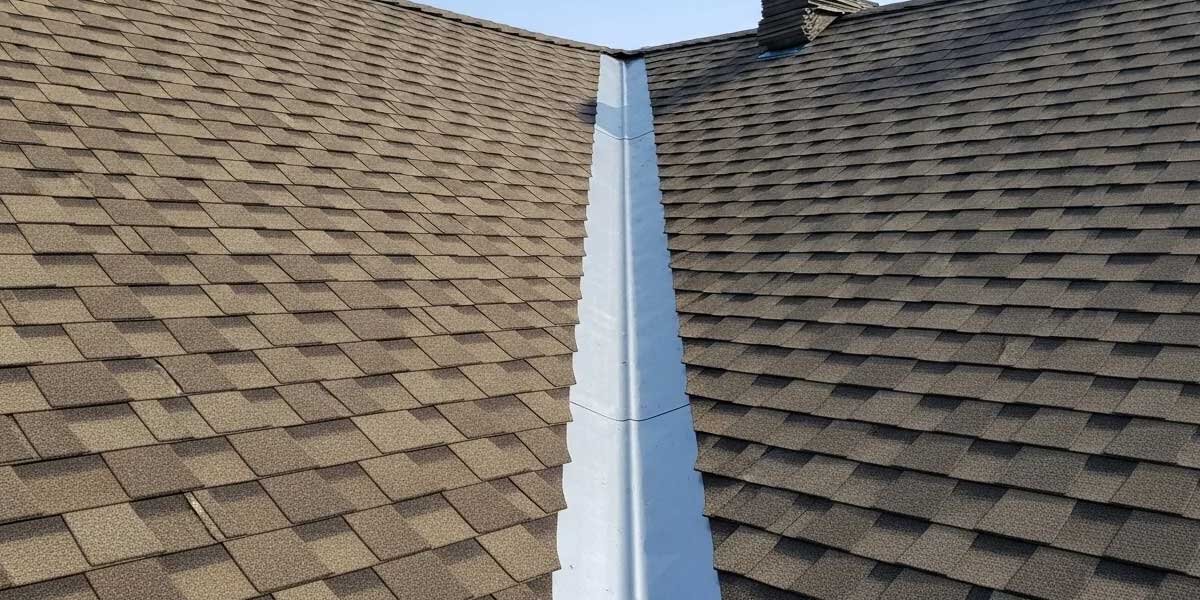
Valley metal is the formed metal channel — typically W-shaped in cross-section — that lines the bottom of an open roof valley. It sits on top of the ice and water shield and under the shingles on both sides of the valley, creating a smooth, corrosion-resistant trough that carries water from the two converging roof planes down to the eave without letting any of that water touch the roof deck. The shingles are cut back 3 to 6 inches from the valley centerline, leaving the metal channel exposed along its full length.
The valley metal is the primary waterproofing surface in an open valley. The shingles on either side are cosmetic — they protect the metal’s edges from wind uplift and UV exposure, but the metal itself does the actual work of keeping water out of the roof deck. If the valley metal corrodes through, the ice and water shield underneath is the backup. If both fail, the roof leaks — and a valley leak is the most damaging type of roof leak because valleys concentrate more water than any other part of the roof.
Valley Metal Materials: Which Metal Belongs in Your Roof Valley
The metal in the valley is subjected to the highest water volume and the highest debris accumulation of any component on the roof. The material choice determines whether the valley outlasts the shingles or rusts through while the shingles are still in good condition.
| Material | Typical Lifespan | Cost per Linear Foot (Installed) | Best For | Key Weakness |
|---|---|---|---|---|
| Galvanized Steel (28-gauge) | 20-30 years | $4-$7 | Budget, dry climates | Zinc coating eventually wears; rust at cut edges |
| Galvalume Steel (24-gauge) | 30-50 years | $6-$12 | Standard residential asphalt shingle | Cut edge corrosion in coastal salt air |
| Aluminum (0.032 inch) | 30-50 years | $8-$15 | Coastal homes, salt air resistance | Softer; dents from debris impact |
| Copper (16-20 oz) | 50-100+ years | $15-$30 | Slate, tile, copper, historic roofs | Expensive; patina changes color |
| Lead-Coated Copper | 70-100+ years | $20-$40 | Premium slate and tile | Very expensive; limited availability |
| Stainless Steel | 60-100+ years | $18-$35 | Industrial, extreme coastal, high-debris | Highest cost; overkill for most residential |
Galvalume steel — steel coated with an aluminum-zinc alloy — is the standard valley metal for most residential asphalt shingle roofs. The coating provides roughly twice the corrosion resistance of galvanized steel at a modest cost premium. For a typical roof with 40 linear feet of valleys — common on a house with two dormers — the upgrade from galvanized to Galvalume costs $80 to $200 and buys an additional 10 to 20 years of valley life.
Copper valley metal is the premium choice. It does not rely on a factory coating for corrosion resistance — the metal forms a self-healing patina over time that seals scratches and cut edges. A copper valley on a slate or tile roof will outlast the fasteners holding it in place. Copper valley metal on an asphalt shingle roof is uncommon because the shingles will wear out twice before the copper shows any sign of age.
The gauge rule: Valley metal thickness is measured in gauge — lower numbers are thicker. 24-gauge (0.024 inch) is the minimum for residential valley metal. 28-gauge is too thin — it dents under foot traffic and wears through from debris abrasion within 15 to 20 years. If a roofer quotes galvanized valley metal, ask the gauge. If the answer is 28-gauge, upgrade to 24-gauge Galvalume.
The W-Shape: Why Valley Metal Is Not Flat
Valley metal is formed into a W-shape — a central V-channel with upturned edges — rather than left flat, for two reasons specific to how water behaves in a valley.
The central V diverts water away from the shingle edges. On a flat metal sheet, water spreads across the full width and runs directly against the cut edges of the shingles on both sides. A V-shaped center channel concentrates the water flow into the middle of the valley, away from the shingle edges. The water that does reach the shingle edge is a thin film rather than a deep stream, and it is less likely to work its way under the shingle.
The upturned outer edges create a dam against wind-driven water. The outer ¾ to 1 inch of the valley metal is bent upward at roughly a 45-degree angle. Wind-driven rain that blows up the valley surface hits the upturned edge and is deflected back into the center channel, rather than blowing over the edge and under the shingle. The upturned edge also provides a clean, straight line for the roofer to cut the shingles against — the shingle edge is trimmed to the top of the upturned flange, leaving the metal channel fully exposed.
How Valley Metal Is Installed on a Roof
Valley metal installation is a sequence that must be followed in order. Each step depends on the previous one being done correctly, and a shortcut at any point creates a leak path that water will find within the first year.
- Ice and water shield goes down first. A 36-inch-wide strip of self-adhered ice and water shield membrane runs the full length of the valley, centered on the valley line. This is the backup waterproofing layer. It seals around any roofing nails driven through it during shingle installation.
- Valley metal goes on top of the ice and water shield. The metal is formed into the W-shape and cut to length. Each 10-foot section overlaps the section below it by at least 6 inches, with the upper section lapping over the lower section — water must flow over the seam, not into it. The overlap seam is sealed with a bead of butyl or urethane sealant.
- The metal is nailed at the outer edges only — never in the center channel. Nails are placed every 12 to 18 inches along the outer 1 inch of the metal, where they will be covered by the shingles. A nail driven through the center channel creates a hole directly in the water path and will leak within the first year.
- Shingles are installed over the outer edges of the metal. The shingles on each roof plane are cut in a straight line along the top of the upturned edge flange, leaving 3 to 6 inches of metal exposed on each side of the center V. The exposed metal channel is what carries the water.
- Shingle cut ends are sealed to the metal. A bead of roofing cement or a strip of adhesive sealant is applied where each shingle edge meets the valley metal, preventing wind from lifting the cut shingle edges.
The most common valley metal installation error: The upper section of valley metal laps under the lower section instead of over it. This reverses the shingling direction and creates a seam that water flows into instead of over. The seam leaks within the first heavy rain. The fix requires removing the shingles on both sides of the valley, pulling the metal, and re-installing it in the correct lap direction. It is a $1,000 to $2,000 repair for a mistake that costs zero dollars to avoid during installation.
Valley Metal Replacement Cost
Replacing valley metal on an existing roof costs $600 to $1,800, depending on the valley length, the metal material, and whether the shingles on both sides of the valley need to be replaced as part of the repair. The cost includes removing the shingles along the valley on both sides (typically 2 to 3 feet of shingle width), removing the old valley metal, installing new ice and water shield, installing the new valley metal, and re-shingling the area. A valley metal replacement that also requires decking repair — because the old valley leaked and rotted the plywood underneath — adds $300 to $600 per sheet of decking replaced.
During a full roof replacement, valley metal is installed as part of the new roof at a cost of $6 to $30 per linear foot for Galvalume through copper. A typical house with 40 linear feet of valleys adds $240 to $1,200 to the total roof cost for standard Galvalume valley metal.
FAQ: Common Questions About Valley Metal
Why would a roofer weave shingles instead of using valley metal?
A woven valley is faster and cheaper to install than an open valley with metal — it requires no metal fabrication and no shingle cutting. It costs roughly $150 to $300 less per valley. The trade-off is lifespan: a woven valley lasts 10 to 20 years on three-tab shingles and is not recommended at all on architectural shingles, which are too thick to weave cleanly. An open valley with Galvalume metal lasts 30 to 50 years. The $300 saved on installation day becomes a $1,200 valley repair 15 years later.
Can you paint valley metal to match the shingles?
You can paint galvanized or Galvalume valley metal with an exterior-grade metal primer and paint, but the paint will peel within 3 to 5 years and require repainting. Copper valley metal should not be painted — the natural patina is the corrosion protection, and paint interferes with patina formation. If you want valley metal that matches the shingle color, order pre-painted Galvalume valley metal from a metal roofing supplier. The factory-applied PVDF paint matches the shingle manufacturer’s color palette and carries a 30-year fade warranty.
Preparing for these operational transitions also involves assessing the underlying structural features of your commercial property. Integrating heavy alternative energy installations requires a roof layout that is entirely secure, well-insulated, and capable of managing long-term weather exposure without developing hidden structural leaks. Evaluating the current state of your building’s exterior envelope can help ensure that any incoming upgrades are properly supported over their decades of service. Facility managers can get more information regarding professional structural assessments and materials to maintain full architectural stability before finalizing new layout designs.
Valley Metal Is the Hardest-Working Piece of Metal on Your Roof
Six inches wide, 10 feet long, buried under shingle edges on both sides — the valley metal is invisible from the ground and the most important waterproofing component on a complex roof. It carries hundreds of gallons of water per storm, resists abrasion from shingle granules and tree debris washing through the valley, and must outlast the shingles that cover its edges.
When a roof is replaced, the valley metal is replaced with it. The material choice — 24-gauge Galvalume for most homes, aluminum for coastal, copper for slate and tile — determines whether the valley is still watertight at year 40 or whether it rusted through at year 25, while the shingles above it still had a decade of life left.