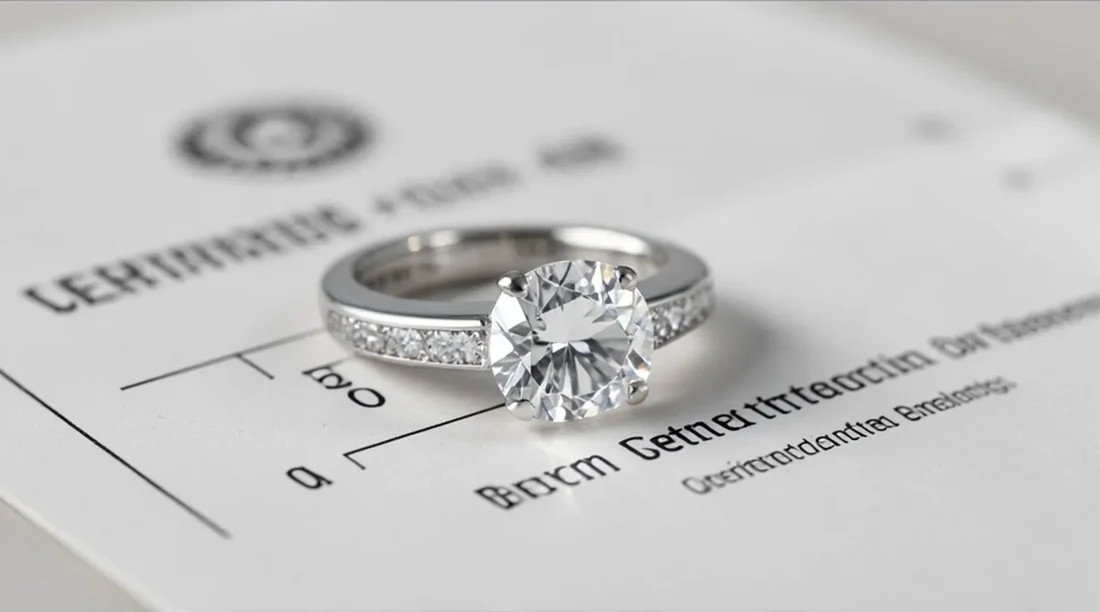
The word certified does an enormous amount of work in jewellery retail and means considerably less than buyers assume.
There is no single standard behind it. Different laboratories grade to different levels of strictness, some sellers issue their own documents, and one widely used report format changed fundamentally in late 2025.
Here is what these documents actually are, which ones carry weight, and what to check before you pay.
A report is not a valuation
The first and most common confusion.
A grading report describes the physical characteristics of a stone. Carat weight, colour, clarity, cut where applicable, measurements, proportions, treatments, fluorescence and often a laser inscription number. It contains no monetary figure at all.
A valuation or appraisal states what it would cost to replace the piece. It is produced by a qualified valuer, it is what an insurer wants, and it is a completely separate document.
You need both for an item of any significance. People routinely hand an insurer a grading report and are surprised when it is not accepted.
The laboratories and why the difference matters
There is no international regulator. Laboratories are independent commercial or non-profit bodies and they grade to their own standards.
GIA, the Gemological Institute of America, developed the four Cs and the D to Z colour scale. It is a non-profit, it does not buy or sell stones, and it is generally regarded as the strictest and most consistent. Its reports carry the most weight internationally.
AGS, the American Gem Society Laboratories, is similarly well regarded and was historically strongest on cut analysis.
IGI and HRD are large international laboratories whose reports appear widely, particularly on laboratory-grown stones. Their grading has often been regarded as somewhat more generous than GIA’s.
Smaller and in-house laboratories vary enormously.
The practical consequence is that grades are not directly comparable between laboratories. A stone graded G VS1 by one laboratory may grade H VS2 by another, and since each grade step carries a price difference, that gap is worth money. When comparing two stones, compare the laboratory as well as the grades.
A certificate issued by the seller is not third-party verification. It may be entirely honest, and it is not independent, for the obvious reason.
What is actually on a report
Worth knowing how to read one rather than glancing at the grades.
Carat weight, to two decimal places.
Colour, D through Z for natural colourless stones, where D is completely colourless. Fancy coloured stones use a separate scale entirely.
Clarity, from flawless through internally flawless, VVS, VS, SI and I, based on what is visible under ten times magnification.
Cut grade, from excellent to poor. Important caveat: this appears only for round brilliants. Fancy shapes, ovals, pears, emeralds, cushions and the rest, receive no cut grade, which is a significant gap because cut is the property that most affects appearance.
Measurements and proportions, including table percentage, depth percentage, crown and pavilion angles. For a fancy shape with no cut grade, these numbers are the only objective information you have about proportions.
Polish and symmetry, graded separately.
Fluorescence, the stone’s reaction to ultraviolet light.
The clarity plot, a diagram showing the position and type of inclusions. This is more useful than the clarity grade itself, because an inclusion under a claw is irrelevant and one in the centre of the table is not.
Comments, where treatments and other notable characteristics are disclosed. Read this section.
A laser inscription number, if present, matching the report.
Treatments which live in the comments
Several treatments are common and all should be disclosed.
Fracture filling injects a glass-like substance into surface-reaching fractures to make them less visible. It is not permanent and can be damaged by heat during repairs, which is why a jeweller needs to know before working on a stone. GIA does not issue full grading reports for fracture-filled diamonds.
Laser drilling creates a tiny channel to reach and bleach a dark inclusion. Permanent and disclosed.
High pressure high temperature treatment can alter colour in some stones. Disclosed as treated colour.
Irradiation is used to produce coloured diamonds artificially, including pinks and blues.
That last point matters commercially. For any fancy coloured stone, the report should state whether the colour is natural, treated or laboratory-grown. Natural colour carries the value. Treated and laboratory-grown coloured stones look similar and hold essentially none.
The change that happened in late 2025
The single most important recent development.
The Gemological Institute of America stopped applying its D to Z colour scale and its flawless to included clarity scale to laboratory-grown diamonds. Those stones now receive one of two descriptive categories instead: premium or standard.
The reasoning is sound. The four Cs were designed to describe variation arising from geology. In a controlled reactor, high colour and clarity are process parameters rather than lucky accidents, so most output clusters at the top of the scale and the grade stops discriminating.
It also ended a comparison that was economically misleading. A laboratory stone and a natural stone described identically on paper differ in price by an order of magnitude.
The practical consequence for a buyer: you can no longer glance at a report format and know what you are looking at. Ask explicitly whether a stone is natural or laboratory-grown, every time.
This matters because the two are not distinguishable at retail. Laboratory-grown diamonds are diamond, with the same crystal structure, refractive index, hardness and thermal conductivity. Every handheld tester reads them as diamond, correctly. Identification requires spectroscopy in a laboratory, looking for growth artefacts such as metallic flux inclusions, striated growth structure or phosphorescence patterns.
The documentation is the only safeguard available at the point of sale.
Who pays for certification
A small point that explains why some stones have reports and others do not.
Grading costs money per stone, and the fee is broadly similar whether the stone is worth five hundred dollars or fifty thousand. That is why certification is standard above roughly half a carat and unusual below it, where the fee would be a significant fraction of the value.
The cost sits with whoever submits the stone, usually the cutter or the wholesaler, and it is recovered in the price. So a certified stone is not more expensive because certification adds value. It is more expensive partly because the certification fee is in there.
This also explains why melee, the tiny accent stones set into halos and pave bands, is almost never individually certified. Those stones are bought and sold in parcels graded as a group.
Verifying a report
Thirty seconds, free, and almost nobody does it.
Every major laboratory maintains a public online database. Enter the report number and confirm that the specifications displayed match the document you have been shown.
This catches two things: reports that do not exist, and genuine reports paired with a different stone.
Where a stone carries a laser inscription on its girdle, a jeweller can show you the number under magnification so you can confirm it matches the report. For anything significant, ask.
Where certification matters most
Any natural diamond above about half a carat should have an independent report. Below that, the grading cost becomes disproportionate and most small stones are sold without one, which is normal.
Every fancy coloured stone, without exception, because origin of colour is the entire question.
Any stone being bought as a store of value.
Australia has a specific case worth knowing. The Argyle mine in Western Australia produced more than 90 per cent of the world’s pink diamonds before closing permanently in November 2020, and Rio Tinto’s final inventory tender concluded in October 2025. Supply is now fixed and stones with verified Argyle provenance trade at roughly 20 to 50 per cent above comparable pinks of other origin.
That premium rests entirely on documentation: the laser inscription, the Argyle certificate and lot number in agreement with each other, ideally alongside a GIA coloured diamond report confirming natural colour origin. A pink diamond without that chain is a pink diamond. With it, it is an Argyle pink diamond, and the market prices those very differently.
Jewellers dealing in this material routinely, including Perth workshops such as those making Stelios Jewellers engagement rings with Argyle stones, treat the paperwork as part of the object rather than as an accessory to it.
Fluorescence and why it is worth understanding
One line on a report that most buyers skip and that can genuinely save money.
Roughly a third of diamonds fluoresce under ultraviolet light, usually blue, because of the way nitrogen defects are arranged in the crystal. Reports grade it from none through faint, medium, strong and very strong.
The trade has argued about this for decades. Strong blue fluorescence can make a slightly warm stone appear whiter in daylight, because daylight contains ultraviolet and the emitted blue offsets the yellow. In that case it is a free optical improvement. In a small minority of stones, very strong fluorescence can produce a slightly hazy or oily appearance.
The pricing is the interesting part. Fluorescent stones generally trade at a discount even where the effect is neutral or beneficial, which means a buyer who understands the property can frequently get a better stone for less money.
The sensible approach is to treat fluorescence as a reason to look at the stone rather than as a reason to reject it on paper.
What certification does not tell you
Worth being clear, because a report creates confidence that can exceed what it supports.
It does not tell you the stone is beautiful. Two stones with identical specifications can look noticeably different, particularly in fancy shapes with no cut grade.
It does not report bow ties, the dark band across the centre of elongated brilliants caused by light leakage. You have to look.
It does not value the stone.
It does not assess the setting, the workmanship or the metal.
And it does not make a bad cut good. A report is a description, not an endorsement.
The language sellers use
A short glossary of phrases worth interrogating, because each one sounds like a guarantee and is not.
Certified diamond. Certified by whom. The word alone means nothing without the laboratory named.
Certificate of authenticity. Usually issued by the seller and confirming only that they sold it.
Lab certified. Ambiguous by design. It can mean a report from a recognised gemmological laboratory, or it can mean a laboratory-grown stone, and occasionally both at once.
Appraised at. An appraisal figure quoted alongside a much lower selling price is a marketing technique, not evidence of value. Ask who appraised it and whether they were independent of the sale.
Conflict free. A meaningful commitment in principle, and the term is not independently audited in most retail contexts. Ask what specific scheme or documentation supports the claim.
Ideal cut and super ideal. Marketing terms rather than grading terms. GIA’s top cut grade is excellent, and anything above it is a seller’s description.
None of these phrases are necessarily dishonest. They simply are not the same as a verifiable report number from a named laboratory, and they should not be treated as interchangeable with one.
What to do with the report afterwards
A practical note, since the document has a working life beyond the purchase.
Record the report number somewhere separate from the report itself. If the physical document is lost, most laboratories will issue a replacement or confirm the details from the number.
Keep a copy in cloud storage alongside photographs of the ring and the valuation. A house fire that takes the ring usually takes the paperwork with it, and a claim is far easier with documentation.
And if the stone is ever recut, reset or repolished, the existing report no longer describes it accurately. Recutting changes carat weight and can remove a laser inscription, so anything significant should be recertified afterwards.
The short checklist
Ask which laboratory issued the report, and treat GIA and AGS as the benchmarks.
Verify the report number online before paying.
Read the comments section for treatments.
Ask directly whether the stone is natural or laboratory-grown, because the report format no longer tells you.
Check the plot to see where the inclusions sit, not just the clarity grade.
For a fancy shape, look at the proportions, because there is no cut grade.
And get a separate valuation for insurance, because the report is not one.
This article is general information only. Grading standards and report formats change. Verify certification directly with the issuing laboratory.